
Vision Shopping
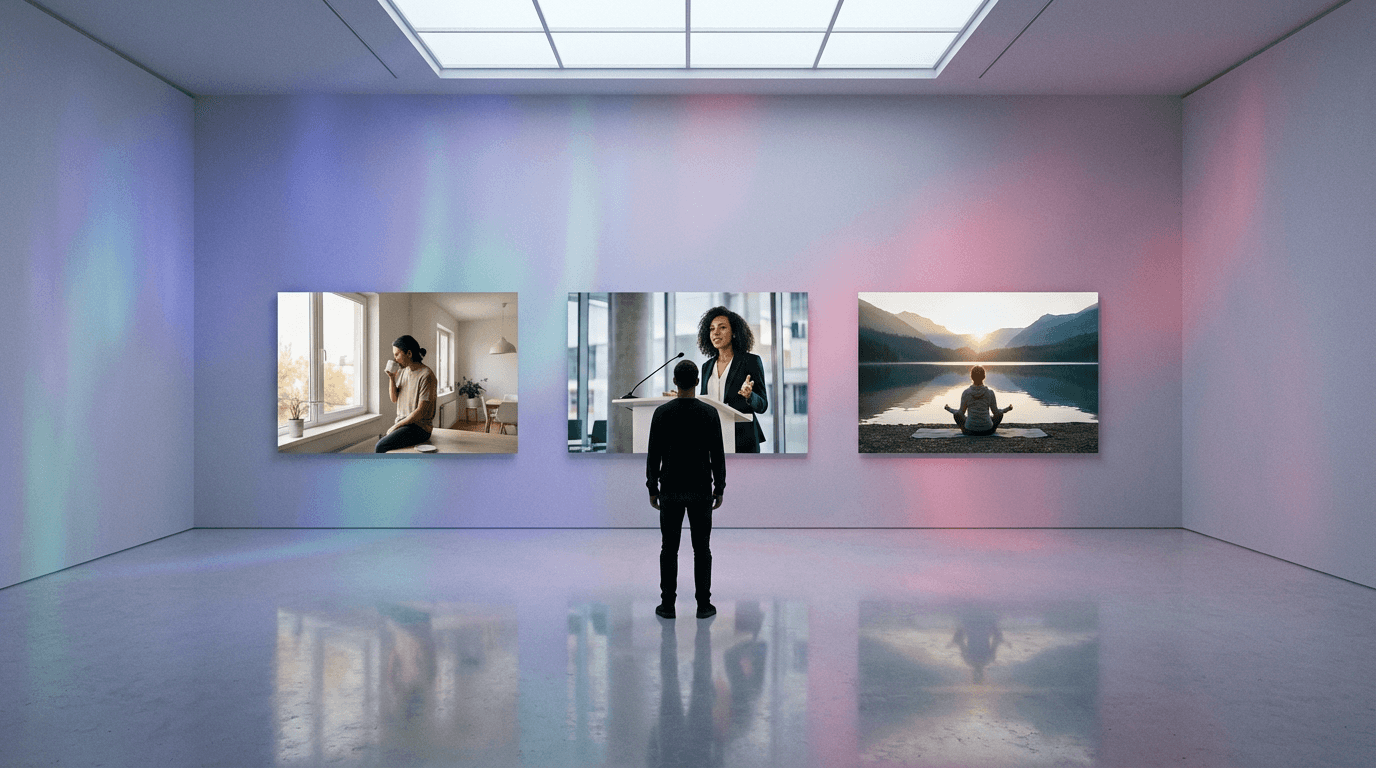
You don't need perfect clarity to start. You just need a direction to try on. Generate a few versions of your future, notice what resonates, and let your taste reveal what you truly want.
Why people get stuck
Most tools assume you already know what you want. But in real life, the hardest part is often deciding what actually fits. When you can't picture the outcome, committing feels risky — so you stall, second-guess, or chase goals that look good on paper but don't feel right.
This isn't a character flaw. It's a prediction problem: humans are famously bad at forecasting what will actually feel good long-term, especially when the goal is vague (freedom, love, success) and the real-life details matter (pace, people, environment, routines).
Vision Shopping flips the order: you don't start with certainty. You start with exploration, and clarity emerges from contrast.
Try on futures
Start with a feeling, a vague idea, or a messy paragraph. Visionframe generates distinct visual directions so you can compare what's possible.
Notice resonance
The goal isn't perfection — it's recognition. Some images will feel flat. Others will feel like relief, energy, or truth. That reaction is your signal.
Choose what fits
You're not choosing an image. You're choosing an environment, a pace, a vibe, and a version of you that feels natural.
Refine until it's aligned
Refinements tighten the match. You move from "interesting" to "that's it."
Why Vision Shopping works
It's a simple loop: create contrast, let your reaction do the sorting, then tighten the match. Here's what's happening under the hood.
Contrast creates clarity
One image is easy to overthink. Three directions create meaningful comparison, so your preferences show up fast (calm vs. high-energy, minimal vs. warm, quiet vs. social).
You stop chasing "should"
When goals are abstract, it's easy to borrow someone else's definition of success. Seeing concrete scenes helps you notice what feels self-concordant (aligned with your actual values) instead of performative.
You learn the feeling, not the fantasy
Pretty outcomes can trick you. Vision Shopping keeps you grounded in lived details (the morning, the workday, the home atmosphere) so you choose a future you can actually inhabit.
Refinement becomes a process
Instead of one "perfect prompt," you iterate. That shift matters: process thinking (how it looks and feels day-to-day) helps you move from vague desire to a direction you can take seriously.
What to look for
When an image is right, it often triggers one of these signals:
Expansion
"Yes. More of this."
Relief
"This feels safe. Like I can breathe."
Energy
"This makes me want to move."
Truth
"I don't know why, but this is mine."
Tip: don't only pick what's "most impressive." Pick what you'd genuinely repeat on an ordinary Tuesday.

Ready to try on a few futures?
Start vague. Let the images do the heavy lifting. Keep what resonates — and let that become your direction.